Breaking a tooth can be unsettling, especially when you cannot tell how serious the damage is by looking at it.
The good news is that many broken teeth can be repaired. However, not every broken tooth can be treated in the same way, and some teeth may be too extensively damaged to restore appropriately.
The right approach to broken tooth repair depends on much more than how large the break appears. Your dentist needs to consider the location and depth of the fracture, how much healthy tooth remains, whether the pulp has been affected, the condition of the gums and bone, your symptoms, and how the tooth functions.
At Northside Family Dentistry, treatment begins with an individual evaluation so patients can understand what has happened and why a particular treatment may be recommended.
What Determines Whether a Broken Tooth Can Be Saved?
A tooth that looks badly broken is not automatically beyond repair. Likewise, a small-looking crack may sometimes extend farther than expected.
Your dentist may consider:
- How much healthy tooth structure remains
- Where the fracture is located
- Whether the break extends below the gumline
- Whether the pulp inside the tooth has been affected
- Whether decay or infection is present
- The condition of the gums and supporting bone
- How the tooth functions within the bite
- Previous dental work
- Your symptoms and overall oral health
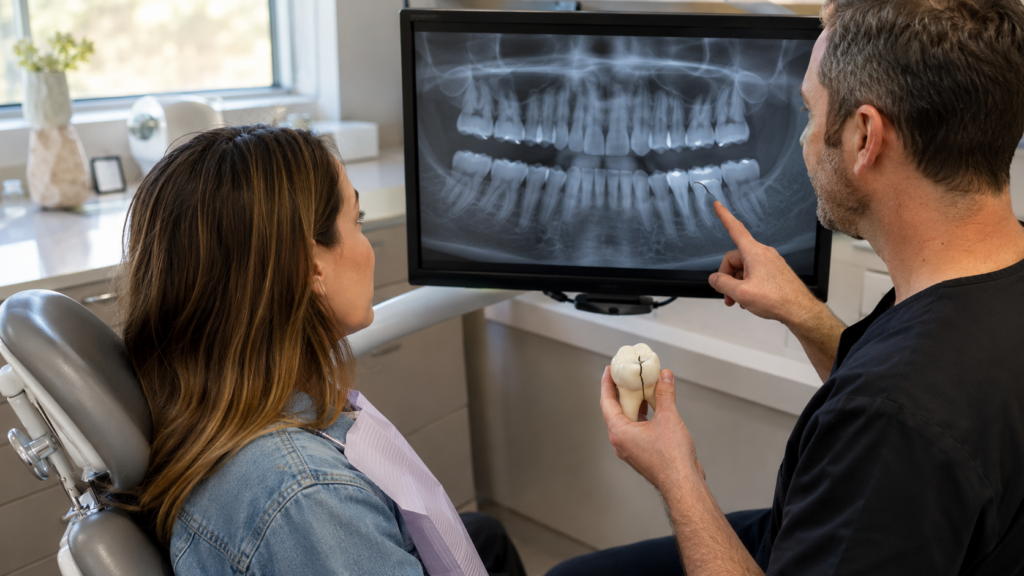
Dental X-rays and a clinical examination can provide additional information that may not be visible from the outside.
The decision is therefore based on the entire condition of the tooth, not simply whether a piece has broken off.
How Does the Location of the Break Matter?
Where a tooth breaks can be just as important as how much structure is missing.
A limited chip involving the outer portion of a tooth may have very different treatment needs from a fracture extending toward the pulp or below the gumline.
The dentist also needs to determine whether important structural areas of the tooth remain intact.
A break that looks small from one angle may involve a larger weakened area, while another tooth with a more noticeable chip may still have enough healthy structure for relatively conservative treatment.
This is one reason photographs and symptoms alone cannot reliably determine the treatment.
Minor Chips May Need Only Conservative Treatment
Small chips do not always require extensive restorative work.
Depending on the location and condition of the tooth, bonding may be an option. Tooth-colored material can be shaped to restore a small missing area and improve the tooth’s form and function.
In other situations, fillings may be considered when a relatively limited portion of tooth structure has been lost or when decay contributed to the damage.
The goal is to repair the damaged area while preserving healthy natural tooth structure whenever that is clinically appropriate.
Larger Breaks May Need a Crown
When a larger portion of a tooth has broken away, bonding or a filling may not provide enough coverage or support.
A dental crown covers a larger portion of the remaining tooth and may be considered when the tooth has been substantially weakened.
Northside Family Dentistry also offers same-day crowns. For appropriate patients and teeth, this technology may allow a crown to be completed in one appointment.
However, same-day treatment is not automatically appropriate for every broken tooth. The dentist first needs to determine what restoration the tooth actually requires.
What If the Break Reaches the Inside of the Tooth?
Inside a tooth is soft tissue called the pulp.
A deep fracture or significant injury can expose or damage this tissue. When that happens, root canal therapy may become part of the treatment discussion.
Root canal therapy addresses damaged or infected tissue inside the tooth. It does not determine by itself whether the entire tooth can be saved.
The dentist still needs to consider how much healthy structure remains, where the fracture extends, and whether the tooth can reasonably be restored afterward.
Root canal therapy is a confirmed service at Northside Family Dentistry.
How Do Decay and Previous Dental Work Affect Repair?
A tooth may break because of trauma, but damage can also occur when the tooth has already been weakened.
Decay can reduce the amount of healthy structure available to support a restoration.
Previous fillings or other dental work can also influence treatment planning because less natural tooth structure may remain than in a tooth that has never been restored.
That does not mean a previously treated tooth cannot be repaired.
It simply means the dentist needs to evaluate what healthy structure remains and whether the proposed restoration can appropriately address the current damage.
When Might a Broken Tooth Need to Be Removed?
Some broken teeth are too extensively compromised to restore reasonably.
A tooth extraction may be considered when the fracture extends into areas that make restoration difficult, when too little healthy tooth remains to support treatment, or when other significant structural concerns are present.
Extraction is not automatically the first choice just because a tooth is broken.
The dentist first evaluates whether preserving the natural tooth remains a reasonable option.
What Happens If the Tooth Cannot Be Saved?
If a tooth needs to be removed, your dentist can discuss whether replacing it is appropriate.
Possible tooth-replacement categories may include dental bridges, dentures, or dental implants depending on which tooth is involved, the condition of the surrounding teeth and tissues, bone, bite, overall oral health, and individual goals.
The replacement decision is separate from deciding whether the original tooth can be repaired.
The priority is to develop a treatment plan that supports function and long-term oral health rather than assuming every extracted tooth should be replaced in exactly the same way.
Is a Broken Tooth a Dental Emergency?
Some broken teeth need more prompt attention than others.
Contact a dentist promptly if the break is accompanied by:
- Significant or worsening pain
- Swelling
- Bleeding that does not readily stop
- A large portion of the tooth breaking away
- Difficulty biting or chewing
- A loose tooth
- An injury involving the teeth or mouth
Even if the tooth does not hurt, having the damage evaluated is still important.
A painless tooth can still have structural damage, and a dentist can determine whether treatment is needed and how quickly it should be addressed.
Northside Family Dentistry provides emergency dentistry for dental concerns requiring prompt professional attention.
Why Can Waiting Make Treatment More Complicated?
It can be tempting to ignore a broken tooth when it is not painful.
However, damaged tooth structure may continue to weaken or fracture further. Chewing on the affected tooth could place additional stress on an already compromised area.
If damage progresses toward the pulp or another part of the tooth becomes involved, the treatment needed may also change.
An evaluation does not automatically mean extensive treatment will be recommended. It gives the dentist an opportunity to determine what has happened and explain what options are appropriate.
What If You’re Nervous About Dental Treatment?
A broken tooth can already be stressful, and dental anxiety may make the situation feel more difficult.
Northside Family Dentistry emphasizes patient comfort, clear communication, and helping patients understand what to expect.
The dental team can explain what they find, why a particular treatment is being discussed, and what alternatives may be appropriate.
For selected patients, oral sedation may also be considered based on individual needs and the planned procedure. Oral sedation is confirmed at the practice, but it is not automatically necessary or appropriate for every broken tooth.
Questions to Ask About a Broken Tooth
You should understand why a particular repair is being recommended.
Helpful questions may include:
- How deep does the damage appear to be?
- Where does the fracture extend?
- How much healthy tooth structure remains?
- Has the pulp been affected?
- Can the tooth reasonably be restored?
- Why are you recommending this treatment?
- Are other appropriate treatment options available?
- How quickly should the tooth be treated?
- What could happen if I wait?
Clear answers can help you participate in treatment decisions rather than assuming that every broken tooth needs the same procedure.
The Right Repair Depends on the Tooth
So, can every broken tooth be repaired? No, but many can.
A minor chip may need only bonding or a filling. A more extensively damaged tooth may require a crown. If the pulp has been affected, root canal therapy may become part of the treatment plan.
When too little healthy structure remains or the fracture is too extensive, extraction may be considered.
The important point is not to determine the treatment based only on how the tooth looks or whether it hurts.
Northside Family Dentistry takes a personalized approach to restorative care, combining patient education, gentle treatment planning, and modern dental technology to help patients understand their options.
If you have broken or chipped a tooth, contact Northside Family Dentistry to schedule an evaluation and learn what treatment options may be appropriate.